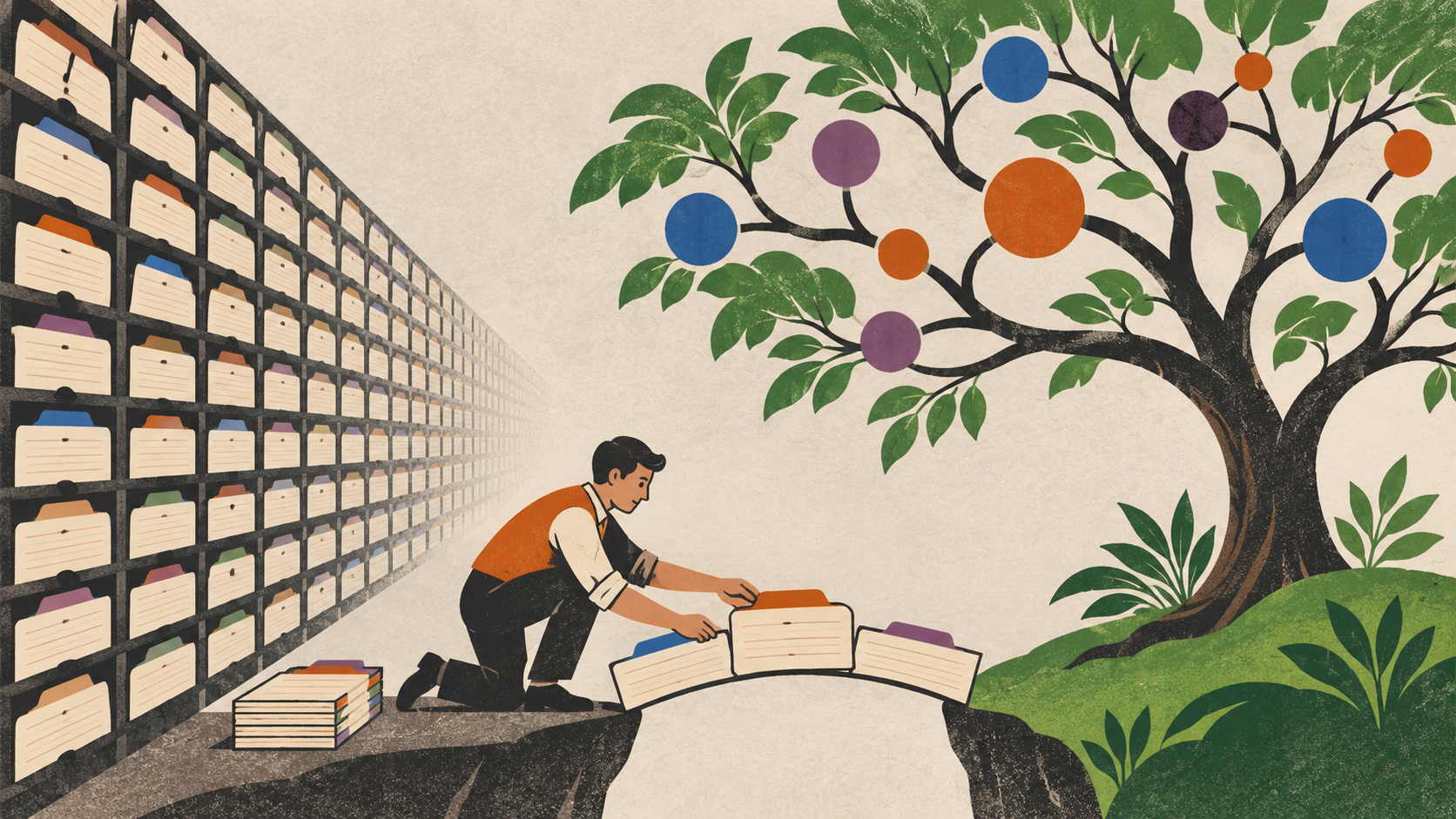
You save an essay about decision-making. Highlight a book about learning. Bookmark a thread about a framework that might change your work. Your collection grows, and for a moment, so does your sense of progress.
Then a real problem arrives. The idea feels familiar, but you cannot explain its mechanism, remember its limits or decide whether it applies.
You have acquired access. Have you acquired understanding?
Christian Tietze calls this the collector’s fallacy: mistaking the accumulation of information for the development of knowledge. His essay captures the uncomfortable gap between having a resource and doing the mental work that makes it useful. The Collector’s Fallacy
The answer is not to stop saving things. An archive is valuable. The problem begins when collecting becomes a substitute for thinking, rather than its starting point.
A library is not a learning process
A bookmark answers one question: Where can I find this again? Understanding answers others: How does this work? Why should I believe it? When would I use it?
Those are different jobs.
We do not need every address, quotation or technical detail inside our heads. External references let us spend less effort remembering where information lives. But when the goal is judgment, performance or insight, a well-organised folder cannot do all the work.
Consider opportunity cost. Recognising the phrase is one thing. Explaining that a choice gives up the best available alternative is another. Using it to decide whether your team should build a new feature or fix an unreliable checkout is something else again.
The difference is not how impressive your notes look. It is what the idea enables you to do.
Familiarity can disguise a missing explanation
In 2002, Leonid Rozenblit and Frank Keil investigated the illusion of explanatory depth. Across a series of studies, people often rated their understanding of mechanisms more highly than their subsequent explanations justified. Attempting to explain exposed gaps that confidence alone had concealed. The effect was especially pronounced for explanatory knowledge, rather than being equally strong for every kind of knowledge. Rozenblit and Keil, 2002
That distinction matters. Feeling familiar with a diagram is not the same as being able to reconstruct the process it represents.
Try it with something ordinary. How does a zip stay closed? How does a bicycle stay upright? Choose one, then explain the mechanism without looking it up.
The useful moment is where your explanation stops being specific. “The parts work together” is not a mechanism. It is a signpost pointing towards something you still need to learn.
This is not a reason to distrust everything you know. It is a reason to give confidence a practical test.
Four questions that test usable knowledge
Instead of asking only whether an idea looks familiar, ask four questions:
- Can I retrieve it? Describe the central claim without reopening the source.
- Can I explain it? Show the steps connecting the cause to the outcome.
- Can I connect it? Identify what it supports, contradicts or changes in something you already know.
- Can I apply it? Use it in a new situation, and describe where it might fail.
These are practical prompts, not a scientific scoring system. You might explain a principle well but struggle to apply it under pressure. You might perform a skill competently while finding it hard to describe in words.
The point is to stop using recognition as the only measure of learning.
For opportunity cost, retrieval gives you a definition. Explanation shows why a limited budget makes alternatives matter. Connection links it to prioritisation. Application forces you to compare actual options, including the option of doing nothing.
Try the distinction
From familiar to usable
Choose a step to see what it asks of you. This is a practical self-check, not a validated test or a fixed learning sequence.
“I've seen this before.”
You recognize a term or an example while it is in front of you.
Example: You recognize the phrase “opportunity cost” in a saved article.
Give it a try
Look away from the source. Can you still say what the idea means?
“I can bring it back.”
You retrieve the idea without looking at the source.
Example: You describe opportunity cost from memory, then check what you missed.
Give it a try
Write a two-sentence definition from memory. Compare it with the original and correct it.
“I can explain why.”
You connect the idea to a mechanism, an example, and a boundary.
Example: You explain why a “free” meeting can still have a cost, and what alternative you are giving up.
Give it a try
Explain the idea to a curious beginner. Name one case where your explanation would not fit.
“I can use it here.”
You test the idea in a new situation and use feedback to revise your understanding.
Example: You compare two projects by the best alternative each would displace, then review the result.
Give it a try
Pick a real decision this week. Write how the idea changes your choice, then revisit the outcome.
You can move back and forth between these actions. Familiarity is a starting point, not proof of mastery.
Close the source before writing the note
One of the simplest changes is also one of the least comfortable: read, close the source, and reconstruct the idea from memory. Then reopen it and correct yourself.
In a 2006 experiment, Henry Roediger and Jeffrey Karpicke compared restudying prose passages with taking a recall test. Extra study helped on a test minutes later, but initial testing produced better retention after longer delays. The activity that felt like checking learning also helped create it. Roediger and Karpicke, 2006
A practical note can therefore begin with three unfinished sentences:
- The main claim is...
- It works because...
- I am still uncertain about...
Do this before copying the author's best sentence. Otherwise, a polished quotation can conceal the fact that you have not yet built an explanation of your own.
Then compare your account with the source. Keep the correction visible. A note that records how your understanding changed is more useful than one that merely looks complete.
Explain the connection, not just the conclusion
Self-explanation adds another layer. Rather than repeating what a passage says, ask why one step follows from another, how it connects to prior knowledge, and what assumptions it depends on.
In a small 1994 study, Michelene Chi and colleagues prompted eighth-grade students to explain lines of a text about the circulatory system. The prompted group showed greater gains than a comparison group that read the text twice. This was a specific learning task, not proof that talking through anything guarantees mastery. It nevertheless illustrates the value of actively constructing connections. Chi and colleagues, 1994
For a claim about the world, build a short claim, mechanism, boundary note:
Claim: What is being proposed?
Mechanism: What would make it happen?
Boundary: Under what conditions might it not hold?
For example, “smaller teams move faster” becomes more useful when you ask whether fewer coordination links explain the effect, whether specialist skills are missing, and whether the task can actually be divided.
Also ask what the evidence establishes. If successful teams happen to be smaller, that association does not by itself show that reducing a team's size will improve performance. The context or the way teams were selected might explain both. A model is a way to investigate a decision, not a slogan that decides for you.
Test the idea somewhere new
Learning a definition is not the same as recognising when to use it. Application needs practice too.
Andrew Butler's 2010 experiments found that repeated testing improved performance not only on retained material but also on new inferential questions, compared with repeated study. The result supports practising retrieval beyond verbatim repetition, without implying that every fact automatically transfers to every real-world problem. Butler, 2010
Try creating two examples and one counterexample for an idea. If you have just learned about sunk costs, compare abandoning an unused subscription with continuing a difficult project whose future benefits still justify the remaining work. Both involve past spending. They need not lead to the same decision.
This forces you to separate the principle from the story in which you first encountered it.
For professional learning, go one step further. Turn a note into a small deliverable: a revised onboarding screen, a worked calculation, a decision memo or a testable prediction. Reality can provide feedback that your highlighting cannot.
Return after the easy feeling has faded
A single good explanation is a beginning, not a guarantee of lasting access.
Nicholas Cepeda and colleagues studied spaced learning with more than 1,350 participants. Their findings showed that the interval between study sessions mattered, and that the most useful spacing depended on how long information needed to be retained. There is no single perfect review interval for every goal. Cepeda and colleagues, 2008
As a starting routine, revisit an important idea the next day, the following week, and later when a relevant problem appears. Adjust to what you can actually recall. Attempt retrieval before rereading, and use the source to repair omissions or errors.
The aim is not to maintain a flawless streak. It is to make important ideas available when you need them.
Make the collection serve the work
You do not need to process every saved article. Some things deserve deep study, some are references, and some were only interesting for a moment.
Give a saved item a job. Is it helping answer a question, improve a skill, make a decision or preserve a source? If it has no current job, let it remain an archive item without pretending it is an unfinished obligation.
For the ideas that matter, use a short loop: read, retrieve, explain, apply, revisit. Leave a visible output at each pass. A paragraph. A diagram. A corrected assumption. A better decision.
The most useful question at the end of a reading session is not “How much did I save?”
It is: What can I now explain, notice or do that I could not before?
Credit: Christian Tietze, Zettelkasten